
Expert ultrasound angiology — training, 144 h | МЕДТРЕЙН Asia
Angiology · Expert

Expert ultrasound angiology

Expert competencies in vascular ultrasound according to the ASE 2025, BSE 2024, IAC-VT 2024, ESVS 2022 and SRU 2023 standards — for those who set the bar.

144academic hours
Expertlevel
Distance learningmode of study

Course curriculum

  • Cervical segments of the carotid and vertebral arteries and transcranial examinations
    • — Doppler angle: alignment with the flow or with the wall
    • — Correct angle setting as the basis of reliable quantitative diagnosis
    • — Real cases are analyzed where the walls and flow direction do not coincide, and a 5–10° error leads to clinically significant deviations
    • — Do the specialist, the technique and the equipment create critical errors
    • — Analysis of human, technical and methodological factors that can distort the results of a duplex examination
    • — Practical approaches to self-assessment and internal quality audit
    • — Assessment of the carotid intima-media complex at the present stage
    • — Current protocols of IMT measurements, «vascular age», ASE 2008 / ESC 2021 standards
    • — Features of imaging the near and far walls, assessment of site representativeness and normal ranges
    • — Review of the IAC consensus criteria for internal carotid artery stenosis
    • — Evolution from SRU to IAC 2024, new threshold values for PSV, EDV and velocity ratios
    • — Step-by-step adaptation of the laboratory to the updated requirements
    • — Criteria for stenosis of the common, external and vertebral arteries
    • — Velocity parameters, characteristic spectra, and typical pitfalls in the assessment of the ECA and VA
    • — How to avoid over- and underestimation of stenosis in borderline segments
    • — Carotid duplex: incidental pathology
    • — Dissections, thrombi, mycotic aneurysms, radiation fibrosis and compression syndromes
    • — Reporting strategy and recommendations for the clinician
    • — Duplex assessment in Eagle syndrome
    • — The styloid process as a source of vascular compression
    • — Arterial, venous and neurogenic variants, anatomical correlates and an approach to formulating the conclusion
    • — Intracranial arteries examination protocol
    • — Complete TCD / TCI examination algorithm: MCA, ACA, PCA, BA, VA
    • — PRF settings, correction angle, MFV recording and documentation of flow directions
    • — Non-invasive assessment of intracranial hypertension
    • — Use of the pulsatility index (PI) for an approximate assessment of ICP
    • — Critical thresholds, calculation using the Bellner formula, monitoring of PI over time
  • Lower extremity arteries and visceral vessels
    • — Duplex assessment of lower extremity arterial disease
    • — Protocols per ESVS 2022, stenosis criteria by PSV and Velocity Ratio
    • — Features of distal assessment and spectrum interpretation in occlusion and reconstruction
    • — Arteries after angioplasty and stenting
    • — Diagnosis of restenosis and hemodynamics in the intervention zone
    • — Comparison of velocity parameters in native and stented vessels
    • — Non-atherosclerotic diseases of the lower extremity arteries
    • — FMD, adventitial cysts, medial calcinosis, vasculitides
    • — Spectral signs, differential diagnosis, interpretation errors
    • — Duplex examination of the aortoiliac segment
    • — Technique for identifying inflow lesions
    • — PSV thresholds, VR, runoff assessment, and principles of GLASS classification
    • — Duplex examination and PAT: modern assessment of perfusion
    • — Integration of PAT (Pulse Acceleration Time) into ischemia assessment
    • — Combining PAT with ABI and WIfI for limb loss risk stratification
  • Venous block
    • — Nomenclature and variants of describing venous pathology
    • — Modern CEAP terminology, compartments, saphenous and non-saphenous trunks, perforators
    • — Correct report construction and designation of reflux sources
    • — How to interpret spectra in the common femoral vein
    • — Algorithm for phasicity analysis, detection of EIV/CIV obstructions
    • — Examples of post-thrombotic changes and their reflection in the report
    • — Acute or “chronic” thrombosis
    • — Modern SRU 2018 / SFMV 2024 classification
    • — Signs of thrombus organization, recurrence criteria, wording of conclusions
    • — How to induce venous reflux
    • — Physiological maneuvers (Valsalva, augmentation, Paraná test)
    • — Time-based diagnostic thresholds for different venous segments
    • — Key information for the phlebologist
    • — The DEAR principle (Depth – Evaluation – Anatomy – Reflux)
    • — Minimum dataset for choosing ablation or sclerotherapy tactics
    • — Complications after venous interventions
    • — EHIT, PASTE, EGIT (ESVS 2022): post-ablation changes and follow-up tactics
    • — How to describe thrombosis in the coagulation zone and formulate the conclusion correctly
  • Visceral and renal syndromes
    • — Superior mesenteric artery syndrome
    • — Aortomesenteric angle < 25°, distance < 8 mm, dilatation of the proximal duodenum
    • — Differentiation from MALS and external compressions
    • — MALS (Median Arcuate Ligament Syndrome)
    • — Duplex criteria for celiac trunk compression: PSV > 320 cm/s on expiration
    • — Approach to Diagnosis and Assessment of Decompression Effectiveness
    • — Diagnosis of renal artery diseases
    • — Classical criteria of stenosis (PSV ≥ 200 cm/s, RAR > 3.5)
    • — Poststenotic turbulence, tardus-parvus, monitoring of stents and grafts
    • — Fibromuscular dysplasia of the renal arteries
    • — Multifocal "string of beads" form, V₂/V₁ ≥ 2–2.5
    • — Differences from atherosclerotic stenosis and the specifics of its description
    • — Nutcracker syndrome
    • — D-ratio and V-ratio ≥ 4–5 in the presence of clinical signs
    • — Criteria for hemodynamic significance and the SVU / ESVS protocols
    • — Ultrasound assessment of the central veins
    • — VTOS, May–Thurner, IVC obstruction, pelvic venous reflux
    • — SVP classification (AVLS 2018) and pelvic vein scanning protocol

A flagship expert program for ultrasound physicians, cardiovascular surgeons, and angiologists. You will master the standardized interpretation of duplex studies of the arterial and venous beds — carotid, visceral, renal, and peripheral — in full accordance with current international guidelines.

This is the level at which your reports become the benchmark of quality in the clinic.

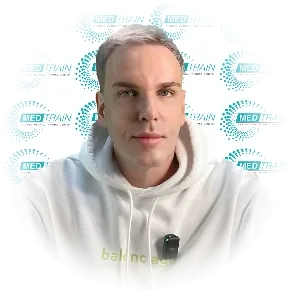
Blagodir Boris Vladislavovich

Scientific Director of the MEDTRAIN Training Center, expert physician in ultrasound diagnostics

Blagodir Boris Vladislavovich — scientific director of the MEDTRAIN Training Center, ultrasound diagnostics expert physician with 22 years of experience and 13+ years of teaching. He conducts author's courses on echocardiography and vascular ultrasound, combining rigorous protocols with a clear step-by-step methodology. Quality marker: completed advanced programs at Gulfcoast Ultrasound Institute, ASE Learning Hub, Mayo Clinic, SVM; member of AIUM, president of the Eurasian Association of Ultrasound and Functional Diagnostics Specialists. Learn from a practitioner who turns complex algorithms into clear decisions.

Scientific director of MEDTRAIN. 22 years of clinical work in ultrasound diagnostics; 13+ years of training physicians: from basic echocardiography to expert vascular ultrasound and functional diagnostics.

Core competencies

  • Echocardiography (quantitative chamber assessment, diastole, valvular defects, prostheses, GLS/Strain).
  • Vascular ultrasound (carotid territory, transcranial studies, arteries/veins of the lower extremities, visceral and renal vessels, post-procedural states).
  • Abdominal ultrasound, obstetrics and gynecology (basic and advanced protocols).
  • Internal quality audit and report standardization.

Educational track

  • Abdominal Ultrasound Registry Review — Gulfcoast Ultrasound Institute, 2021.
  • Duplex/Color Evaluation of Venous Insufficiency — Gulfcoast, 2021.
  • Best of Echo Florida, 2022.
  • Adult Echocardiography — Gulfcoast, 2022.
  • OB/GYN Ultrasound Registry Review — Gulfcoast, 2022.
  • Advanced Echo — ASE Learning Hub, 2023.
  • Destination + Livestream Courses — Mayo Clinic, 2023.
  • ASE RPVI Online Review Course, 2023.
  • SVM Comprehensive Review of Vascular Ultrasound, 2023.
The programs listed are completed courses and reviews. We deliberately do not claim certificates that the course does not formally award.

Memberships and roles

  • Member of AIUM (The American Institute of Ultrasound in Medicine).
  • President of the Eurasian Association of Ultrasound and Functional Diagnostics Specialists.

Teaching approach

  • Only validated protocols and clear if/then algorithms.
  • Plenty of demonstrations and analysis of real cases.
  • Measurement checklists and report templates ready for audit.
  • A clear link between «criterion → clinical decision» so that your reports are accepted at the MDT without questions.

What participants gain

  • A working system: what to measure, how to index, how to formulate conclusions.
  • A materials package: checklists, normal-value tables, report templates.
  • Feedback and support in the chat.

Open Instructor Page →

These courses may interest you

Complete course in ultrasound angiology Advanced
Angiology144 ч

Complete course in ultrasound angiology

The entire path in ultrasound angiology in a single course — from ultrasound physics and vascular anatomy to confident diagnostics of arteries and veins of all vascular beds.
Blagodir B.V. Learn More
Duplex examination of the lower extremity arteries and veins Advanced
Angiology48 ч

Duplex examination of the lower extremity arteries and veins

A focused course on lower-limb vessels: confidently distinguish arterial from venous pathology and correctly assess every finding.

Blagodir B.V. Learn More
Expert duplex assessment of the visceral and renal arteries Expert
Angiology36 ч

Expert duplex assessment of the visceral and renal arteries

Expert level: the diagnosis of rare but clinically significant compression and non-atherosclerotic syndromes that are easy to miss.

Blagodir B.V. Learn More
Спросить Alex Отвечу на любой вопрос · 24/7 · на любом языке