
Primary retraining in the specialty «Ultrasound Diagnostics» — training, 756 h | МЕДТРЕЙН Asia
Primary Retraining in Ultrasound Diagnostics · Beginner

Primary retraining in the specialty «Ultrasound Diagnostics»

Professional retraining in the specialty "Ultrasound diagnostics" (756 h): from scratch to a certificate and the right to practice in the specialty.
756academic hours
Beginnerlevel
Hybrid (In-Person & Online)mode of study

Course curriculum

  • Physical fundamentals of ultrasound
    • — Theory
    • — Fundamentals of ultrasound physics and ultrasound scanning. Ultrasound device settings. Scanning rules
    • — Practice: Getting acquainted with the ultrasound device
    • — Safety regulations
    • — Ergonomics of working with an ultrasound machine
    • — Preparing the Device for Operation. Uninterruptible Power Supply. Rules for Connecting and Changing Transducers
    • — Patient chart: filling in the chart. Saving images and video clips to the ultrasound device memory. The device database and principles of working with the database. Transferring/copying information to removable media in various formats
    • — Cleaning and disinfection of ultrasound transducers
    • — Rules for operating ultrasound transducers
    • — Main controls of the ultrasound device: overall gain, acoustic power, time gain compensation
    • — Additional image optimization technologies: spatial compound imaging (compound), focal zone, speckle reduction, tissue border visualization enhancement, automatic image brightness adjustment, persistence
  • General ultrasound diagnostics
    • — Theory
    • — Ultrasound diagnostics of superficially located organs
    • — Ultrasound diagnostics of the abdominal organs
    • — Ultrasound diagnostics of the urinary system organs
    • — Ultrasound of the uterus and ovaries in normal state
    • — Ultrasound of pathologies of the uterine body and cervix
    • — Ultrasound of pathological processes in the endometrium
    • — Features of ultrasound examination in pediatric gynecology
    • — Features of pelvic ultrasound in postmenopause
    • — First trimester, fundamentals of embryology
    • — Ultrasound in the 1st trimester of pregnancy (normal)
    • — Master class on ultrasound diagnostics of the pelvic organs (abdominal and vaginal)
    • — Introduction to ultrasound scanning of the musculoskeletal system: history; operator-dependent features; transducers and equipment settings for musculoskeletal examinations
    • — Physics of ultrasound scanning: principles and parameters important for studying joints, muscles, and other musculoskeletal structures, including resolution, focusing, and settings
    • — Assessment of ultrasound scanning quality: criteria and recognition of artifacts; distinguishing artifacts from pathologies when scanning joints and soft tissues
    • — Fundamentals of musculoskeletal ultrasound: ultrasound imaging of musculoskeletal structures, anatomy and typical patterns in normal and pathological states, including connective tissues and joints
    • — Ultrasound diagnostics of bones and periosteum
    • — Ultrasound imaging of skeletal muscles. Tendon pathologies. Ultrasound signs of tendinopathies, enthesopathies, and other conditions based on current consensus statements
    • — Ultrasound anatomy of the peripheral nerves
    • — Ultrasound examination of soft tissues and joint components
    • — Main echographic patterns
    • — Knee joint
    • — Hip joint
    • — Application of ultrasound in rheumatology
    • — Practice
    • — Thyroid gland examination protocol
    • — Survey transverse scanning
    • — Transverse scanning of the thyroid lobes (lower, middle, upper segments)
    • — Longitudinal scanning of the thyroid lobes
    • — Scanning the isthmus
    • — Measurements of the linear dimensions of the lobes (height, width, length) and the height of the isthmus
    • — Assessment of thyroid echogenicity
    • — Assessment of thyroid vascularization in color flow imaging mode
    • — Strain elastography of the thyroid gland via carotid artery pulsation. Assessment of patterns by the Rago scale
    • — Measurements of the size and volume of thyroid nodules
    • — Drafting the descriptive part of the report on the results of a thyroid examination
    • — Breast examination protocol
    • — Longitudinal, transverse and radial scanning of the mammary gland
    • — Scanning the areola region
    • — Assessment of the mammary type
    • — Assessment of nodular lesions using the BR system. Structure of the report on breast examination results
    • — Liver and biliary system examination protocol
    • — Longitudinal scanning of the right and left lobes of the liver
    • — Assessment of liver echogenicity
    • — Measurement of the anteroposterior dimension of the liver along the midclavicular line (A-P MCL)
    • — Transverse scanning of the right lobe at the hepatorenal level. Assessment of Morison's pouch and screening for hepatomegaly
    • — Transverse scanning at the level of the porta hepatis. Visualization of the portal vein, common hepatic duct, and common bile duct. Measurement of the dimensions of the hepatic ducts. Assessment of portal vein flow in color flow imaging and PWD modes
    • — Assessment of the hepatic veins: diameter, color flow imaging and PWD
    • — Measurement of the oblique vertical dimension of the liver ("liver length")
    • — Assessment of the inferior vena cava and its inspiratory response
    • — Longitudinal scanning of the gallbladder. Measurement of the gallbladder length
    • — Transverse examination of the gallbladder. Assessment of gallbladder width and height
    • — Assessment of the gallbladder wall
    • — Longitudinal scanning of the head of the pancreas
    • — Transverse scanning of the pancreas. Assessment of echogenicity, measurement of the dimensions of the head, body, and tail of the pancreas. Identification and measurement of the diameter of the pancreatic duct. Assessment of the splenic vein
    • — Report structure for the findings of liver, biliary system, and spleen examination
    • — Pancreas and spleen examination protocol
    • — Longitudinal scanning of the head of the pancreas
    • — Transverse scanning of the pancreas. Assessment of echogenicity, measurement of the dimensions of the head, body, and tail of the pancreas. Identification and measurement of the diameter of the pancreatic duct. Assessment of the splenic vein
    • — Longitudinal scanning of the spleen. Measurement of the spleen length
    • — Transverse scanning of the spleen. Measurement of the width and height of the spleen
    • — Screening for splenomegaly in the "spleen-kidney" section
    • — The concept of hemoperitoneum and methods of its verification
    • — Report structure for the findings of pancreas and spleen examination
    • — Kidney and urinary bladder examination protocol
    • — Longitudinal section of the right kidney
    • — Measurement of the right kidney length
    • — Assessment of right kidney perfusion in color flow imaging mode
    • — Assessment of flow spectrograms at the level of the renal sinus
    • — Transverse scanning of the right kidney. Measurement of the width and height of the right kidney
    • — Longitudinal section of the left kidney
    • — Measurement of the left kidney length
    • — Assessment of left kidney perfusion in color flow imaging mode
    • — Assessment of flow spectrograms at the level of the renal sinus
    • — Longitudinal scanning of the urinary bladder
    • — Measurement of the urinary bladder length
    • — Transverse scanning of the bladder
    • — Measurements of the height and width of the urinary bladder
    • — Assessment of the bladder wall
    • — Imaging and assessment of ureteral jets
    • — Report structure for the findings of kidney and urinary bladder examination
    • — Transabdominal examination protocol of the female pelvic organs
    • — Longitudinal scanning of the uterus
    • — Assessment of uterine orientation: flexion and version
    • — Measurement of the uterine length: body length, cervical length, total uterine length
    • — Assessment of the endometrium and uterine cavity
    • — Transverse scanning of the uterus in the lower, middle, and upper (fundus) segments
    • — Measurements of the height and width of the uterus
    • — Assessment of the myometrium
    • — Longitudinal scanning of the ovaries. Measurement of the ovarian length
    • — Transverse scanning of the ovaries. Measurement of the width and height of the ovaries
    • — Assessment of the retrouterine space
    • — Report structure for the findings of transabdominal examination of the female pelvic organs
  • Echocardiography
    • — Theory
    • — Fundamentals of cardiac anatomy. Fundamentals of cardiac physiology. Preparation for echocardiographic examination. Cardiac access points and sections. Additional ultrasound modalities in echocardiography. Apical, subcostal and suprasternal sections. Transthoracic echocardiographic protocol. Transthoracic echocardiographic protocol "1.1". Transthoracic echocardiographic protocol "2.0". Assessment of left ventricular filling. DEFGEFATE protocols in emergency echocardiography. RUSH protocol
    • — Practice
    • — Echocardiographic imaging in the left longitudinal parasternal view
    • — Left longitudinal parasternal view (LAX LV): 2D mode, color flow imaging. Assessment of chamber size ratio: left/right ventricle, aortic root/left atrium
    • — Assessment of the mitral valve. The concept of prolapse, "flail valve"
    • — Assessment of the aortic valve
    • — Assessment of the coronary sinus and descending aorta
    • — Assessment of the pericardium
    • — Assessment of left ventricular wall contractility
    • — Identification of systole and diastole for the purpose of measuring linear dimensions
    • — Measurement of the right ventricle (RVOTLAX)
    • — Measurement of the left ventricle (IVSd, LVIDd, LVPWd)
    • — Measurement of the left ventricular outflow tract diameter (at mid-systole)
    • — Assessment of myocardial mass and left ventricular geometry
    • — Measurement of the left atrial size. Assessment of the left atrial size
    • — M-mode at the mitral valve leaflets level. Measuring EPSS and DE amplitude
    • — M-mode at the aortic valve level. Assessment of ACS
    • — Left longitudinal section of the aorta (LAX Ao)
    • — Measurement and assessment of aortic dimensions: aortic sinus, sinotubular junction, proximal segment of the ascending aorta
    • — Echocardiographic imaging in the left transverse parasternal view
    • — Left transverse parasternal view at the level of the base of the heart (SAX BASE): 2D mode, color flow imaging
    • — CWD spectrogram of transtricuspid flow
    • — Description and assessment of the tricuspid valve
    • — Description and assessment of the aortic valve
    • — Description and assessment of the pulmonary valve
    • — Measurements of the right ventricle (RVOTprox, RVOTdist)
    • — Measurement of the main pulmonary artery diameter
    • — CWD spectrogram of transpulmonary flow
    • — PWD spectrogram of flow in the RVOT
    • — Left transverse parasternal view at the level of the basal segments of the left ventricle (SAX MV, SAX BASAL)
    • — Assessment of left ventricular shape
    • — Assessment of left ventricular wall contraction at the basal level (regional contractility)
    • — Measurement of the mitral valve orifice area
    • — Left transverse section at the level of the papillary muscles (SAX PM, SAX MID)

A complete professional retraining program in the specialty “Ultrasound Diagnostics” — 756 academic hours: from the physics of ultrasound to diagnostics across all major areas. Upon completion, you receive a document granting the right to practice in the specialty.

A systematic path into a new profession — without gaps and at a comfortable pace.

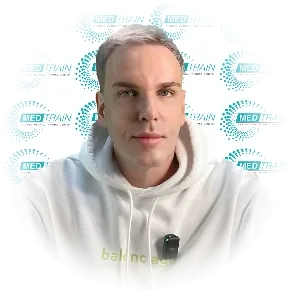
Blagodir Boris Vladislavovich

Scientific Director of the MEDTRAIN Training Center, expert physician in ultrasound diagnostics

Blagodir Boris Vladislavovich — scientific director of the MEDTRAIN Training Center, ultrasound diagnostics expert physician with 22 years of experience and 13+ years of teaching. He conducts author's courses on echocardiography and vascular ultrasound, combining rigorous protocols with a clear step-by-step methodology. Quality marker: completed advanced programs at Gulfcoast Ultrasound Institute, ASE Learning Hub, Mayo Clinic, SVM; member of AIUM, president of the Eurasian Association of Ultrasound and Functional Diagnostics Specialists. Learn from a practitioner who turns complex algorithms into clear decisions.

Scientific director of MEDTRAIN. 22 years of clinical work in ultrasound diagnostics; 13+ years of training physicians: from basic echocardiography to expert vascular ultrasound and functional diagnostics.

Core competencies

  • Echocardiography (quantitative chamber assessment, diastole, valvular defects, prostheses, GLS/Strain).
  • Vascular ultrasound (carotid territory, transcranial studies, arteries/veins of the lower extremities, visceral and renal vessels, post-procedural states).
  • Abdominal ultrasound, obstetrics and gynecology (basic and advanced protocols).
  • Internal quality audit and report standardization.

Educational track

  • Abdominal Ultrasound Registry Review — Gulfcoast Ultrasound Institute, 2021.
  • Duplex/Color Evaluation of Venous Insufficiency — Gulfcoast, 2021.
  • Best of Echo Florida, 2022.
  • Adult Echocardiography — Gulfcoast, 2022.
  • OB/GYN Ultrasound Registry Review — Gulfcoast, 2022.
  • Advanced Echo — ASE Learning Hub, 2023.
  • Destination + Livestream Courses — Mayo Clinic, 2023.
  • ASE RPVI Online Review Course, 2023.
  • SVM Comprehensive Review of Vascular Ultrasound, 2023.
The programs listed are completed courses and reviews. We deliberately do not claim certificates that the course does not formally award.

Memberships and roles

  • Member of AIUM (The American Institute of Ultrasound in Medicine).
  • President of the Eurasian Association of Ultrasound and Functional Diagnostics Specialists.

Teaching approach

  • Only validated protocols and clear if/then algorithms.
  • Plenty of demonstrations and analysis of real cases.
  • Measurement checklists and report templates ready for audit.
  • A clear link between «criterion → clinical decision» so that your reports are accepted at the MDT without questions.

What participants gain

  • A working system: what to measure, how to index, how to formulate conclusions.
  • A materials package: checklists, normal-value tables, report templates.
  • Feedback and support in the chat.

Open Instructor Page →

These courses may interest you

Beginner
Primary Retraining in Ultrasound Diagnostics756 ч

Primary retraining in the specialty «Ultrasound Diagnostics»

Professional retraining in the specialty "Ultrasound diagnostics" (756 h): from scratch to a certificate and the right to practice in the specialty.

Blagodir B.V. Learn More
Спросить Alex Отвечу на любой вопрос · 24/7 · на любом языке